THE TUG MEECHING
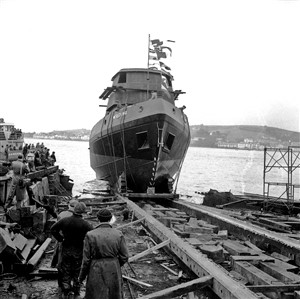
Meeching is launched
Courtesy of Bideford Museum
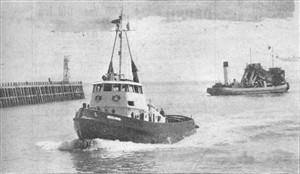
1st June 1960. Meeching passes the dredger Foremost Prince, as she enters Newhaven for the very first time, Fred Holden at the wheel.
Newhaven Museum archives
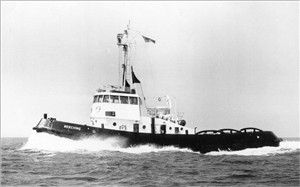
Meeching - Full speed on her first day at Newhaven
BR/Andy Gilbert collection
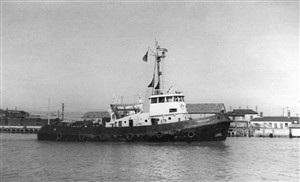
Meeching in 1961
KInd permission of John Hills
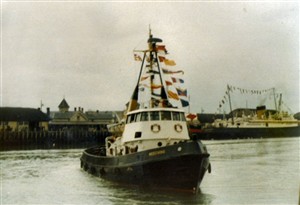
Meeching dressed overall in 1962 - Queen's visit
Newhaven Museum
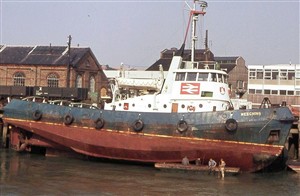
Meeching having a paint-up on the gridiron. Note the sharp edges, or 'chines' of her hydroconic hull form.
Andy Gilbert collection
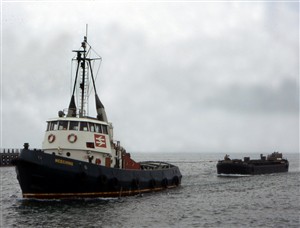
The 'day job' - Meeching and mud barge
Kind permission of Ted Ingham
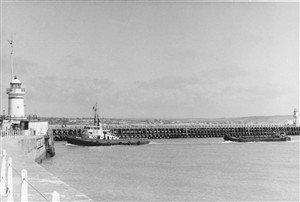
Another view of barge towing - note the West Pier lighthouse is still there and the concrete walls are still in good condition.
Andy Gilbert collection
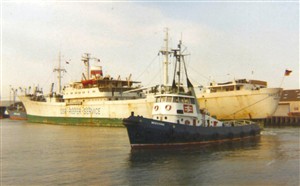
Meeching tows out a freighter
Les Harris collection
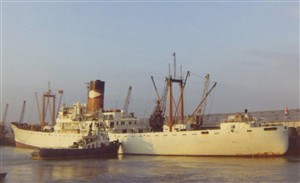
Meeching berths a 'banana boat'
Les Harris collection
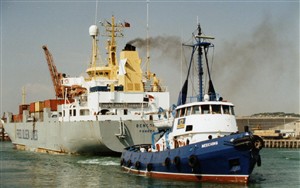
Meeching tows out the Bencomo
Andy Gilbert collection
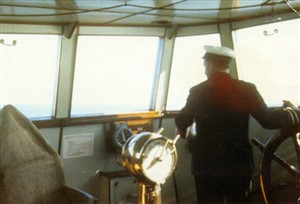
Frank Gilbert at the controls
Andy Gilbert
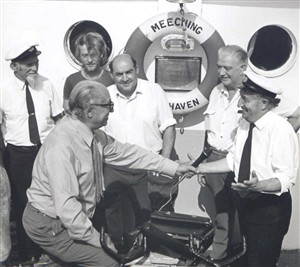
1975 - David Clitheroe records a radio programme for the tug's 15th birthday.
Andy Gilbert collection
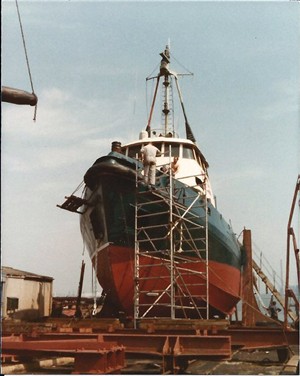
1970's. Refit at Everards, Greenhithe.
Kind permission of Peter Boyd
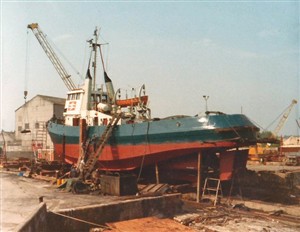
1970's. Refit at Everards, Greenhithe.
Kind permission of Peter Boyd
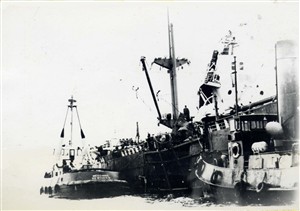
The Crystal Jewel incident
Jim Still
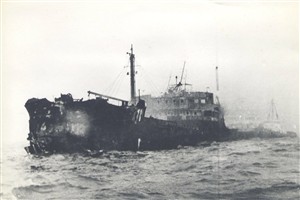
Meeching and the Nora
Andy Gilbert collection
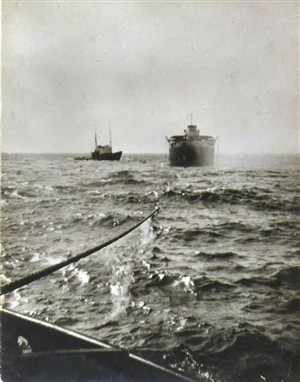
Meeching has Nora under tow, but Hermes closes in.
Andy Gilbert collection
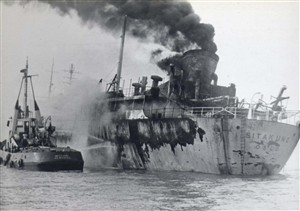
meeching fights the fire on the Sitakund
Andy Gilbert collection
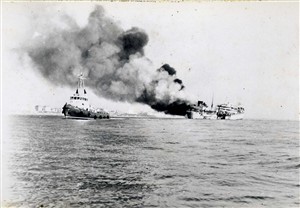
Sitakund under tow off Eastbourne
Andy Gilbert collection
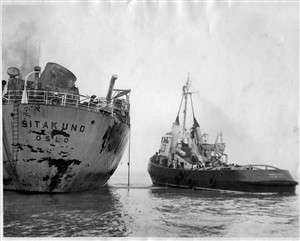
Meeching fights the fire at close quarters
Andy Gilbert collection
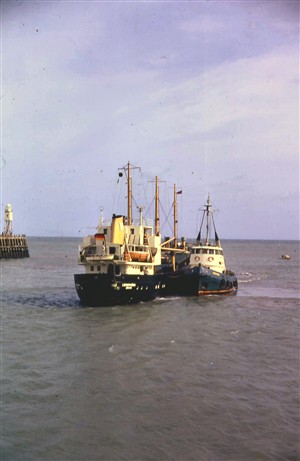
Meeching brings in the Lienerhorn
Andy Gilbert
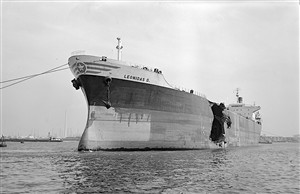
Leonidas D - that's what you call a hole!
Rotterdam Photo Archives
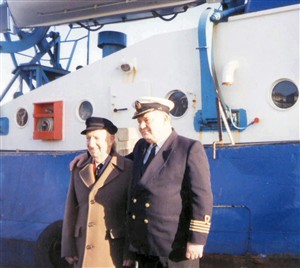
January 21st 2000. Frank Gilbert and Bob Domin at Meeching's retirement
Heidi Watkins
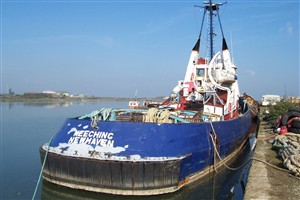
2005 - languishing on the Medway
Jim Still
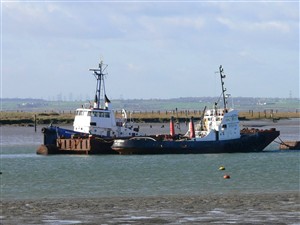
January 2008. Lying at Queenborough with Nore Commodore
Kind permission of Ted Ingham
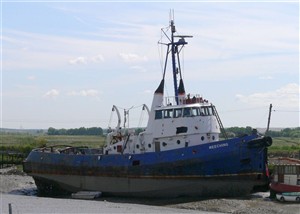
Meeching at Oare Creek, June 2008
Kind permission of Ted Ingham
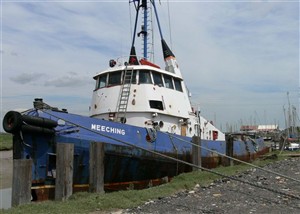
Meeching at Oare Creek, June 2008
Kind permission of Ted Ingham
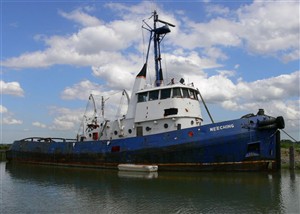
Meeching at Oare Creek, June 2008
Kind permission of Ted Ingham
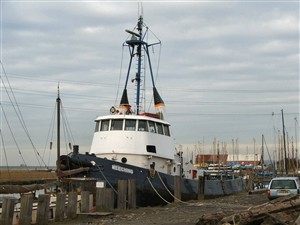
At Oare Creek, March 2009
Andy Gilbert
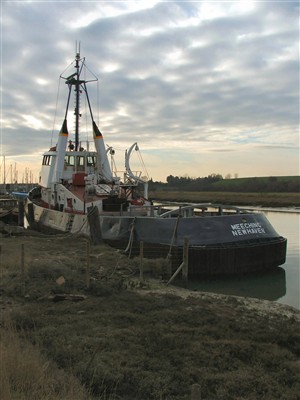
At Oare Creek, March 2009
Andy Gilbert
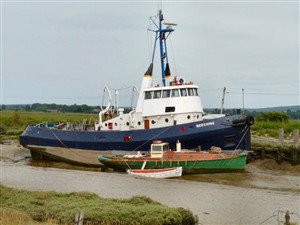
Meeching, June 2009
Kind permission of Mike Jackson
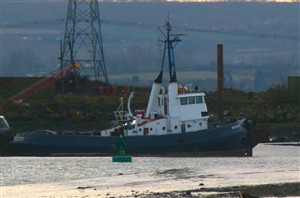
Back at Queenborough, February 2012
Kind permission of Mike Jackson
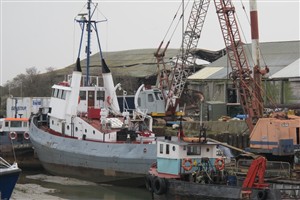
March 2012. Bought by Murray Tugs, Meeching is seen at Klondyke Wharf in Queenborough undergoing restoration.
Kind permission of Mike Jackson
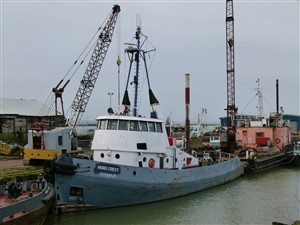
Nore-Crest at Klondyke Wharf, Queenborough. December 26th 2012
Kind permission of Mike Jackson
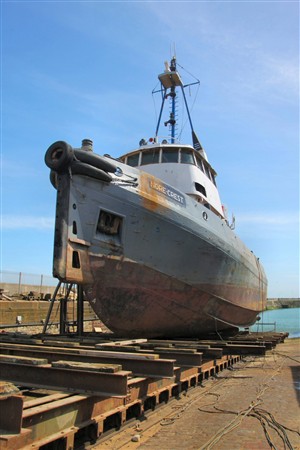
Nore Crest at Ramsgate
Andy Gilbert
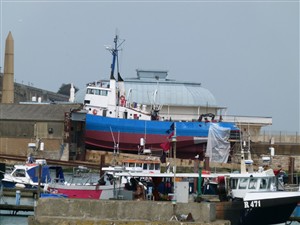
Bright blue!
Kind permission of Mike Jackson
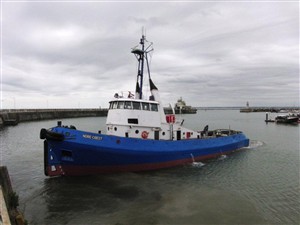
Afloat once more, Nore Crest turns to leave for Queenborough
Kind permission of Ken Larwood
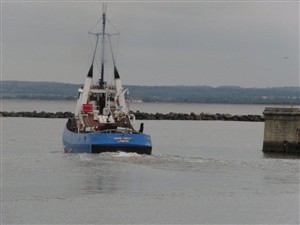
With a puff of smoke from both funnels denoting that she now has both engines running, Nore Crest leaves Ramsgate.
Kind permission of Ken Larwood
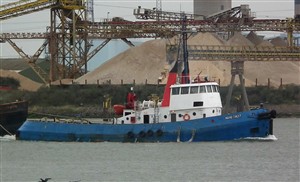
Working on the Thames, October 2014. Much more 'cosmetic' painting has been done!
Kind permission of Mike Robinson
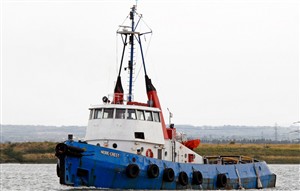
Nore Crest on the Medway, August 2015
Kind permission of mgklingsick on Shipspotting.com
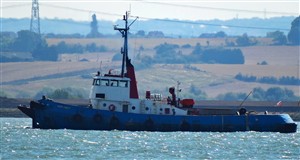
Nore Crest on the Medway, 31st August 2016
Kind permission of 'oldpicruss' on Flickr
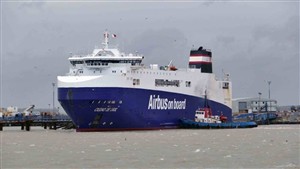
Working hard at Ramsgate, February 2018
Ted Ingham
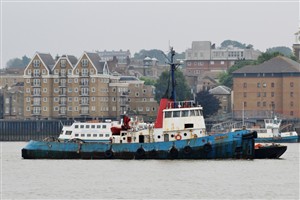
On the Thames, July 2018
Andy Gilbert collection
A potted life history, 1960 - 2018.
By Andy Gilbert
I don't think there can be many long standing Newhaven residents who haven't heard of our former harbour tug Meeching. She served this port well for nearly 40 years and had quite a career.
In the late 1950's Newhaven was a busy port. Not only did we have four fast passenger steamers and three cargo 'screws', but trade was bustling at the North Quay and, being a Railway port, Newhaven was the winter lay-up port for many of the vessels in the company's fleet from all over the UK. There were a lot of shipping movements to be dealt with and, with the whole harbour in use, plenty of dredging to be done. At the time, the port was served by the Foremost 22, a fine Dutch-built tug, and the smaller Tidworth. I'll be polite and say that both tugs were getting on a bit and there was a requirement for something better and more powerful to take Newhaven into the 1960's.
The shipbuilding yard of P.K Harris, of Appledore, in Devon, had been building small vessels for many years and had started to make quite a name for itself as part of Seawork Ltd, a partnership between designers Burness Corlett Ltd, P.K Harris, and Mitchison Shipbuilders of Gateshead. The company was producing tugs based on what was Burness Corlett's patented hydroconic' hull form, with sharp chines and flat full plates instead of the more usual curved hull. (The full details of this are too complex to explain here, and you can find plenty of information on the internet, but it might take a PhD in hydrodynamics to understand it all!) In 1957 and 1958 Harris had delivered two identical twin screw hydroconic tugs, Dominant and Diligent, to the Dover Harbour Board and these two tugs obviously caught the eye of British Railways. Around the same time, the port of Hartlepool, then owned by the British Transport commission - as was Newhaven - had taken delivery of no less than four similar, but smaller hydroconic tugs. So in 1959 they ordered a slightly larger, more advanced and more powerful version for Newhaven.
This tug was to be our Meeching, and she would be a radical change from Foremost 22 and Tidworth. For a start, she would have diesel engines, not steam, enabling her to be under way minutes after the crew arrived on board. She would have twin screws and twin rudders, giving her much greater power and manoeuvrability. The engines would be operated directly from the wheelhouse, with the tug's Master having instant control over them. She would have the latest in radar and radio equipment as well as salvage and fire-fighting gear. In short, in today's parlance, she would be 'the business'! The bosses along the coast at Shoreham were obviously impressed too, as they soon ordered a 'baby' version to be their Kingston Buci.
Meeching was launched on a cold and grey February 25th, 1960 by Miss Pamela Dewdney, daughter of one of the chief British Railways designers who had laid out her specifications, and was brought proudly around to Newhaven on Wednesday 1st June of that year by her first skipper, Captain Fred Holden. She entered service on the 20th July, and Foremost 22 was then put up for sale, along with Tidworth, and Meeching eventually ended up with two full crews. This could not last and eventually this was reduced to one crew, but with two skippers!
Fred Holden's retirement saw my Dad, Frank Gilbert, take over for a while before Alex Pringle took command. Dad went ashore for a little while but was soon back as one of her skippers. Other crew I can remember back in those days included Lawrence "Sally" Flowers as Mate, Bob Patterson as Chief Engineer, my brother Barry Gilbert as 2nd Engineer for a while, and John Watkins as AB. Other names that come to mind include Charlie Stone, Bob Stonehouse, Graham Ware, Eric Boys, Bert Richardson, Don Waller and Eddie Lawless. I'm sure I could recall some more if I thought long enough!
Enough of the crew, but what did Meeching do? Most people will be familiar with her 'day job' for many years, that of towing mud barges out to the 'dump' site a mile and a half or so off the breakwater end. Given good weather, she would start work at just after 6.00am, moving the bucket dredger Testside and her two barges into the required position. Testside had no engines and, having been placed in the correct spot, would then haul herself around using her winches and long wire hawsers fastened to the quayside on both sides of the river. She would fill her first barge and Meeching would pick it up and tow it out to the dump where the barge crew would crank open the bottom doors to let the mud drop out. Meeching would then tow the empty barge back into the harbour and up to where Testside was working. By that time, the second barge would be full, so Meeching would swap them over and tow the second barge to sea. And so it would go on until late afternoon, when it was time to 'clock off' or it got too dark to work, whichever came first! Bad weather or fog could hamper or curtail operations, and when not actually working, Meeching would lay alongside No. 5 stage, where the Lifeboat Station is now. On such days, the crew were often kept busy chipping and painting to keep the tug in good condition. They took real pride in her.
With the 1960's came the car ferries Falaise, Villandry and Valencay, and the real start of the cargo trade at Fishers' berth on the East Quay. These larger vessels meant more work for Meeching and she was always to be seen towing cargo ships in or out, or assisting the ferries in poor weather. This, plus the mud barge work, was to be pretty much her lot for well over thirty years, but she also had one other occasional duty, as she was the only local vessel authorised to carry out burials at sea.
It's probably true to say that nothing much changed until the day that Testside was withdrawn. (The cynic in me would perhaps say that was the day that the harbour started to silt up and decline.) No more mud barges to tow meant that Meeching was alongside doing nothing for much of the time. The decline in trade at Fishers and less need to assist the newer and more powerful ferries meant that the writing was on the wall.
At the end of 1999, I was actually writing a letter to the local press to tell them of the tug's impending 40th birthday, when the Argus headline caught my eye. In huge letters, the word "UNTUGGED" heralded the news that Meeching would be withdrawn with almost immediate effect. There was much protest but the decision had been made and was irreversible. So, on Friday 21st January 2000, almost 40 years to the day after her launch, the Red Ensign was lowered for the final time, accompanied by the Last Post played by Heidi Watkins (daughter of John Watkins) and a salute from her final Newhaven skipper, Bob Domin.
That wasn't the end for Meeching and she lay idle at the port for a year before finally being sold. She worked successfully around the coast for several years but eventually fell into decline. There are all sorts of tales circulating about her, stories of unpaid repair bills, a sinking (or 'flood', depending on who you talk to!), the withdrawal of her 100A1 tug classification due to defects, and more. The truth of all of this? I really don't know, apart from the fact that she was 'detained' by the MCA due to certain deficiencies. In more recent years she was to be seen languishing in a backwater of the Medway, in pretty awful condition. Then came news that she had moved to Queenborough, and was being brought back to life. I had a few 'spies' in the Medway area and they would regularly send me information and photos. She had a lot of work done on her and was sporting a new paint job last year but I was then informed that things seemed to have gone downhill again. She hadn't left her moorings in months and that shiny paint was starting to rust again. She was moored for some time alongside Nore Commodore, her 'replacement' at Newhaven for some years. (I had to laugh when this particular tug arrived, said to be 'more modern and more powerful' than Meeching. OK, she was from 1961 versus 1960, but built to an older design, not quite as powerful and certainly not as capable!)
June 2008. Meeching was moved to Oare Creek at Faversham, where, I was informed, she was being brought back to life. Her twin engines had apparently been rebuilt and the rest of the work was just 'cosmetic'. As you can see from the photos from that time (my grateful thanks as always to Ted Ingham for these) there was quite a lot of cosmetic work to do! More recent photos, which I don't have permission to add, showed that it was progressing.
April 30th 2012. After several years undergoing a very slow restoration at Oare Creek, near Faversham, Meeching was bought by Murray Tugs of Queenborough. She was towed along the coast to Queenborough in February 2012. After a short stop moored off shore where she was once before, next to Nore Commodore, she was brought into a yard at the Klondyke Wharf for full refurbishment. She was due to be be taken out of the water at Ramsgate in May or June for survey and underwater work.
December 26th 2012. Meeching was renamed Nore-Crest, in line with Murray Tugs' naming policy. Refurbishment was still underway, albeit slowly, and the latest photos showed her at Murray Tugs' base at Klondyke Wharf, Queenborough. A new radar, liferaft and other safety equipment are the most obvious changes.
April/May 2013.
Nore Crest went from Queenborough to Ramsgate under her own power for her survey and underwater repairs. Her hull was jet blasted ready for new paint, propshafts and propellers were removed (for possible replacement) and replacement of bearings and seals. Latest photos showed a bright blue hull, and she was re-launched on the 22nd May at 11.30. She then left Ramsgate to return to Queenborough for the final stages of her restoration. It's reported that her new owner Nick Murray had a tear in his eye as she left!
2013-2016. Nore Crest wass busy once again, under Murray Tugs' ownership and was now regularly seen operating on the Thames and the Medway. She had an MCA certificate until 2018, so plenty of life left in her!
2018 - Still hard at work in the Thames, Medway and Ramsgate region. Now past the expiry date of that 5 year MCA certificate, we must assume that she's been inspected again and passed as OK!
Nore Crest, ex Meeching, is now approaching her 59th year, but P K Harris at Appledore, and Mitchisons of Gateshead built their tugs to last and there are plenty of tugs of this age and type from the same yards that are still in use. Goliath, ex MSC Sceptre, is a busy tug/workboat in UK coastal waters. One of the Dover twins, Diligent, is still going strong in Canada as Omni St Laurent, alongside her cousin Helen M McAllister, now Ocean Golf. Kingston Buci is working in the UK as Kingston Lacy and has just been fully restored. Two more of Meeching's close cousins are busy in Greece. Starlet, ex Ekole Creek is working in the port of Volos (and was seen on TV in November 2015 in Michael Portillo's 'Great Continental Railway Journeys' visit to the country - I have sharp eyes and can spot a Harris-built tug in an instant!) and Panagia Soumela, ex Stranton, is operating in Piraeus in Greece. It's good to finally know that Meeching,in her new guise as Nore-Crest, has joined them.
Now, you might be forgiven for thinking that Meeching had a pretty humdrum life and, for the most part, you'd be correct. However she was involved in many dramatic incidents over the years. She had been at the port for about 18 months when the Sugar Tanker Crystal Jewel was struck by the tanker British Aviator. Meeching was first on the scene and had taken the town's GP, Dr Alexander out to deal with casualties. The Crystal Jewel's master had broken both legs jumping from the bridge during the collision but, more tragically, his daughter was killed at the same time. Meeching towed the stricken ship and beached her in Seaford Bay, before another tug took her away to Rotterdam.
The mid and late 1960's saw two more dramatic tanker salvages in the channel. The first was the Nora, a 9,000 ton tanker that collided with the much larger 29,000 ton tanker Otto N Miller at 7.37am on 27th March 1965. She immediately caught fire and Meeching was despatched from Newhaven. Once in attendance, she put out the fires, and with the ship made safe, Meeching prepared to tow her to Rotterdam. Once underway, however, brand new towlines mysteriously snapped, not once but twice, allowing the German salvage tug Hermes to rush in and claim the 'prize'.
The Argus reported at the time that the Nora's master, Captain Trvgve Tyse, had remained on board and had awarded the towage contract to Hermes, but doesn't say whether this was before or after the snapping of the towlines! Either way, Meeching's crew, and British Railways, were not pleased and a settlement was eventually made, but much less than it might have been. It would seem that all is fair in love, war and salvage! To his dying day, my Dad believed that Hermes rode over the towline but nothing could ever be proven. It would be virtually unheard of for a tug company like the one that operated Hermes to do such a thing and there's no one left alive to ask now. However the only photo of the occasion shows Hermes in way too close to a casualty under tow, having been asked to stand clear. We'll never know!
October 1968 saw Meeching's most famous incident involving the Norwegian tanker Sitakund. She caught fire in the shipping lanes off Beachy Head after three large explosions in her tanks. While the Royal Navy frigate HMS Mohawk was warning all vessels to keep clear, and the famous Dutch salvage tug Zwarte Zee was making frantic radio calls offering her assistance, Meeching quietly slipped in and made fast. It was my Dad who made the radio call saying simply "We have taken the casualty in tow, by the stern and are proceeding towards Eastbourne bay". This stunned Mohawk's radio operator into silence for a few moments and you could almost hear the gulp in his voice when he responded with "Roger, wait, out!"
The intention was to beach her off Pevensey, but towing a burning and sinking tanker is not an exact science! She eventually grounded on rocks off Eastbourne Promenade, prompting ridiculous, and uninformed, comments from some of Eastbourne's councillors about her being deliberately placed there! For the next two days, Meeching led the fire fighting operations, along with the Dominant from Dover and personnel from Eastbourne Fire Brigade. Zwarte Zee did eventually turn up and, like Hermes, got too close. My Dad eventually called her up on VHF radio, told her to "Get the Hell out of it" (his exact words) and threatened to turn high-pressure fire hoses on her if she didn't withdraw - she did!
With the fires out, Sitakund then became a tourist attraction for some time. The forward section was towed away in mid 1969 to Falmouth by the tug Englishman, but the burnt out stern section remained for some time longer before eventually being refloated and towed away to Spain.
Other incidents include the story of the Leonidas D, a 28,776 ton bulk cargo ship in distress off Hastings on 23rd April 1970, after being rammed by the Cap San Nicolas, leaving a huge hole in her port side. Meeching again was first on the scene, but the ship was too large for her to handle safely. The owners engaged the Oceanic, at the time the World's largest tug, and she duly took over and dispensed with Meeching's services. Very soon after, she wrapped her towline around her propeller and Meeching was rapidly recalled to hold Leonidas D in position while divers freed the line. Meeching was then engaged as standby tug for the tow to Rotterdam.
I was walking along the harbour wall one breezy summer's day and noticed Meeching was not where she should have been. I went to the West Pier lighthouse and discovered she was on her way in with a broken down coaster, the Lienerhörn. I, along with many others watched the touch and go job as Meeching struggled to bring her in through the 'narrows' in the gusty conditions.
Perhaps the most dangerous incident involved another Newhaven regular of the time, the suction dredger Pen Dart. She had broken down off Shoreham in almost hurricane force winds in February 1970. Shoreham's own tug Kingston Buci was not permitted to leave port in the conditions and so Meeching was dispatched. My Dad said that was the worst weather he'd ever encountered in all his years at sea, with Meeching bucking and rolling like crazy (an unfortunate characteristic of the hydroconic hull design, but she always rolled back upright). The rescue actually involved Meeching going inshore of Pen Dart, putting herself perilously close to shore, before eventually towing her to the safety of Shoreham harbour.
There are many more such stories, but I hope this has given you an idea of what this 98 feet long, 163 ton, 1320 horsepower, maid of all work got up to in her 40 years at Newhaven, and why she is remembered so fondly.
Update: November 2015
It’s always been said that Meeching was “British Railways’ (later Sealink’s) only tug”. In fact it says so in an article on her in the Sealink News magazine, and in reports of her exploits with the Sitakund in Rail News (British Railways’ in-house newspaper). However, this turns out to be not exactly true, at least not at first.
Meeching was P K Harris’s Yard No. 127. A few months earlier, and possibly from the same slipway, Harris launched their Yard No. 124. A very near sister to Meeching, this tug was named Stranton, and was delivered to the British Transport Commission, for duties at Hartlepool. The British Transport Commission was the umbrella organisation set up in 1949 to gather together and nationalise much of the UK’s transport industry, including railways, shipping, docks and harbours. Newhaven and Hartlepool were part of this. Stranton remained under the British Transport Commission’s ownership until late 1963, with the Commission’s abolition, when she was transferred to the Tees and Hartlepool Port Authority. Meeching would have been transferred to the new British Railways Board around the same time. So, technically, for three years, there were at least two ‘British Railways’ tugs, albeit under the name of the Commission. I say ‘at least’ because Stranton had three identical sisters, Seaton, Hart and Throston, built either by P K Harris or by Mitchison at Gateshead. It’s hard to find out the details, but it’s quite possible these were also under British Transport Commission ownership. And it’s quite possible that the Commission’s order for Meeching went hand in hand with the order for the four Hartlepool based tugs. More research required, as always!
I've added a selection of photos from my collection. I've credited those that need it and I do thank Peter Bailey MBE for letting me scan some of the Museum's photos. Mind you, my Dad and I donated quite a few of them in the first place. If I've used any without permission, I apologise, but I think I've covered all the bases!
A much extended version of this page, with around 60 pages of words and photos, now forms a 'Meeching Life History' book at Newhaven Museum.
Andy Gilbert